Red, the Color That Won't Sit Back
The longest wavelength on the screen, and the least patient one.
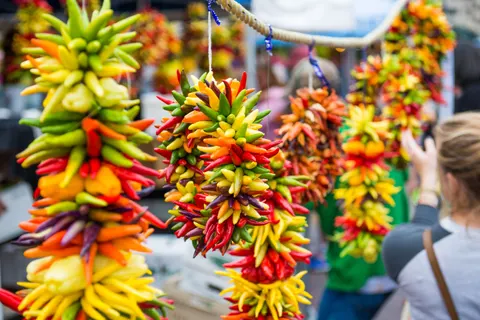
Red sits at the far end of the visible band, past 620 nanometres, and the eye files it as an event in the foreground. In photographs a very small dose is enough: one buoy in a grey harbour, a single maple among a hundred green trees, and the frame reorganises around it. No other colour needs so little area to take the lead.
At dusk it loses its nerve. As the light drops the retina hands over from cones to rods, and rods are nearly blind to long wavelengths, so a red flower goes black while the blue one beside it is still glowing. Cameras have a matching problem: a saturated red pushes the red channel to its ceiling before the other two get anywhere, which is why petals so often come back as a shape with no folds left in it.
On a display the trouble continues. The sRGB red primary is the weakest of the three, wide-gamut panels stretch it further, and a photo balanced on one screen can look sunburnt on the next; JPEG's chroma subsampling also smears red edges more than any other. As a wallpaper it does best in small amounts, a door, a hull, a row of lanterns, with the rest of the desktop quiet and one thing on it refusing to be.