The Wallpaper Other People See
Share your screen and your desktop leaves the room as video, at a small fraction of the bits it deserves.
Screen sharing does not send your desktop, it sends a video of it, usually somewhere between one and three megabits per second for a whole 4K workspace. Fine detail is the first thing a codec gives up. A wallpaper of backlit leaves, gravel or a star field is tens of thousands of tiny high-contrast edges, and the encoder spends its budget keeping them alive instead of on the document you actually opened the call for.
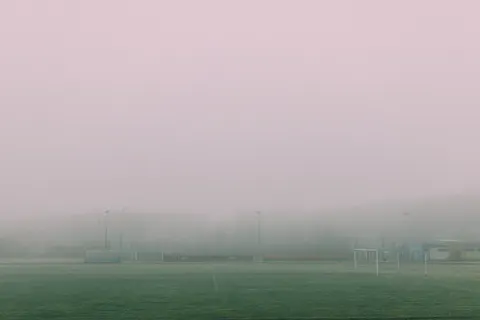
Quiet images travel better. Large smooth areas, few edges, a narrow range of brightness: a gradient, a wall of fog, one field of colour compresses down to almost nothing and leaves the bitrate to the window that matters. The same restraint helps human eyes, since window borders and a moving cursor are easier to follow against a background that is not competing. Very dark pictures are not an automatic win here, because smooth dark skies are exactly where low bitrate leaves visible steps.
So it is reasonable to keep two. The one you look at for eight hours can be as busy as you like; the meeting desktop gets something calmer that survives being re-encoded, scaled down and viewed in a thumbnail on someone else's laptop. Seen that small, restraint is not modesty, it is the only thing that still reads as an image.